USDA forecasts record soybean crop as Iowa corn harvest lags far behind average
Federal forecasters raised their corn and soybean estimates in October, projecting a record soybean harvest, while the latest weekly report shows Iowa farmers far behind their usual pace.
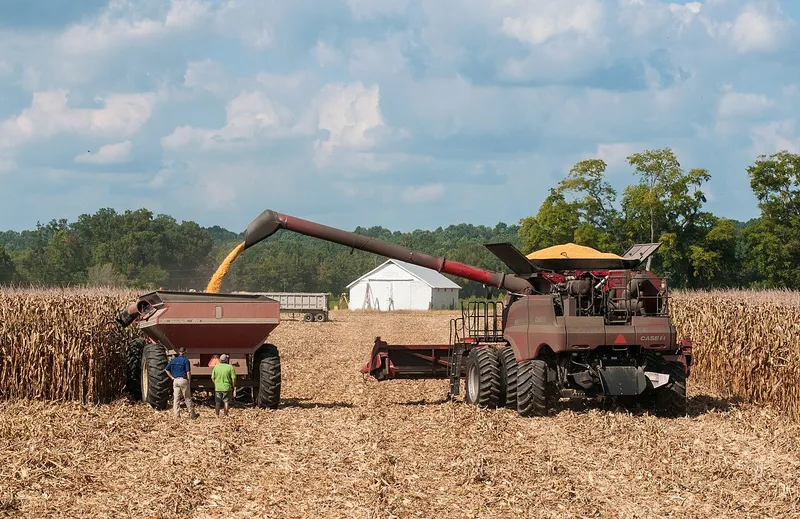
American farmers are on track to harvest the largest soybean crop on record this fall, according to the Agriculture Department’s latest forecast, even as the corn harvest across much of the Corn Belt runs behind its usual schedule.
In its October Crop Production report, released Oct. 9, the National Agricultural Statistics Service forecast soybean production at a record 4.56 billion bushels, up 7 percent from 2025. The agency projected an average yield of 53.1 bushels per acre, also a record, on 85.9 million harvested acres, up from 80.4 million last year.
Corn production was forecast at 16.0 billion bushels, down 5 percent from 2025. The same report put the national corn yield at 181.2 bushels per acre, 5.3 bushels below last year, with harvested area of 88.5 million acres compared with 90.9 million in 2025. Cotton production was forecast at 13.4 million bales, down 3 percent.
Bigger supplies, lower prices
The October figures were higher than the department’s September outlook. In its World Agricultural Supply and Demand Estimates, issued the same day, USDA said soybean output rose 27 million bushels from last month’s forecast because of higher yields. The board noted that the corn outlook calls for “larger supplies, exports, domestic use, and ending stocks.”
Projected corn ending stocks for the 2026-27 marketing year were raised by 282 million bushels to 1.849 billion, according to the WASDE. Part of the increase came from beginning stocks, which were raised 173 million bushels after the Sept. 30 Grain Stocks report. The department lowered its season-average corn price received by farmers by 10 cents, to $4.70 per bushel.
For soybeans, USDA raised projected exports by 10 million bushels, to 1.695 billion, and lifted ending stocks by 5 million bushels to 315 million. The season-average soybean price was left unchanged at $12.00 per bushel.
Wheat growers face a different picture. The WASDE put 2026-27 wheat production at 1.534 billion bushels, slightly higher than before but still “the smallest U.S. wheat production since 1970.” Projected wheat exports were cut 25 million bushels to 750 million, and the season-average price was lowered 10 cents to $6.30 per bushel.
State by state
The national numbers mask wide differences among the top farm states. In the Crop Production report, Iowa’s corn yield is forecast at 219 bushels per acre, up from 210 last year, while Illinois is forecast at 208 bushels, down from 214. Nebraska’s forecast fell to 188 bushels from 194, and Minnesota’s to 195 from 201. Indiana’s corn yield is forecast at 200 bushels, compared with 204 in 2025.
Soybean yields followed a different pattern. Illinois is forecast at 68 bushels per acre, up from 62.5 last year, and Indiana at 63, up from 59.5. Nebraska’s soybean yield is projected at 59 bushels, down from 65.5, and Minnesota’s at 49, down from 52.5.
Harvest pace lags in Iowa
Getting those crops out of the field is taking longer than usual in some states. The agency’s Crop Progress report released Oct. 19 showed that 44 percent of corn in 18 major producing states had been harvested as of Oct. 18, behind the five-year average of 52 percent. A week earlier, the figure was 33 percent, according to the Oct. 13 report.
Iowa had harvested 26 percent of its corn as of Oct. 18, compared with a five-year average of 50 percent, the Oct. 19 report showed. Nebraska stood at 37 percent against an average of 48 percent, and Minnesota at 38 percent against 53 percent. Illinois was ahead of its usual pace, at 63 percent compared with a 58 percent average.
The soybean harvest was closer to normal nationally, at 64 percent complete compared with a five-year average of 65 percent. Iowa soybean growers had harvested 57 percent of their crop, well behind the state’s 74 percent average.
Crop condition held steady. In the 18 states tracked, 56 percent of corn was rated good or excellent, unchanged from the previous week, with Iowa at 72 percent.
USDA’s next supply and demand report is scheduled for Nov. 10, according to the October report.
Sources
- Crop Production (October 2026), USDA National Agricultural Statistics Service, Oct. 9, 2026.
- World Agricultural Supply and Demand Estimates (WASDE-676), USDA World Agricultural Outlook Board, Oct. 9, 2026.
- Crop Progress, week ending Oct. 18, 2026, USDA National Agricultural Statistics Service, Oct. 19, 2026.
- Crop Progress, week ending Oct. 11, 2026, USDA National Agricultural Statistics Service, Oct. 13, 2026.
Patriot Today Editorial reports from primary documents and named sources. Spotted an error? Write to info@atlasmedianetwork.org — see our corrections policy.